
Eco-Friendly & Reclaimed Timber Carpentry in Cornwall
How reclaimed and sustainable timber is used in bespoke carpentry, from sourcing and certification to finishes and the genuine environmental benefits of choosing wood wisely.
Why Timber Is Already the Sustainable Choice
Of all the materials a carpenter works with, timber is uniquely sustainable. Grown by the sun, it sequesters carbon for as long as it is in use, and it can be reused, repurposed, and ultimately returned to the earth. A piece of bespoke joinery built from well-sourced timber is, over its lifetime, one of the lowest-impact things you can put in a home.
The catch is in the sourcing. Not all timber is created equal. Tropical hardwoods logged from old-growth rainforest, or softwood from poorly managed plantations, carry a heavy environmental cost that the beauty of the finished piece can obscure. Choosing timber well is the single biggest lever a sustainable carpentry project has.
That is why we work with certified suppliers, specify locally grown species where we can, and increasingly work with reclaimed timber for clients who want their project to have the lightest possible footprint. The result is joinery that is not only beautiful but genuinely responsible.
Reclaimed Timber: Character and Conscience
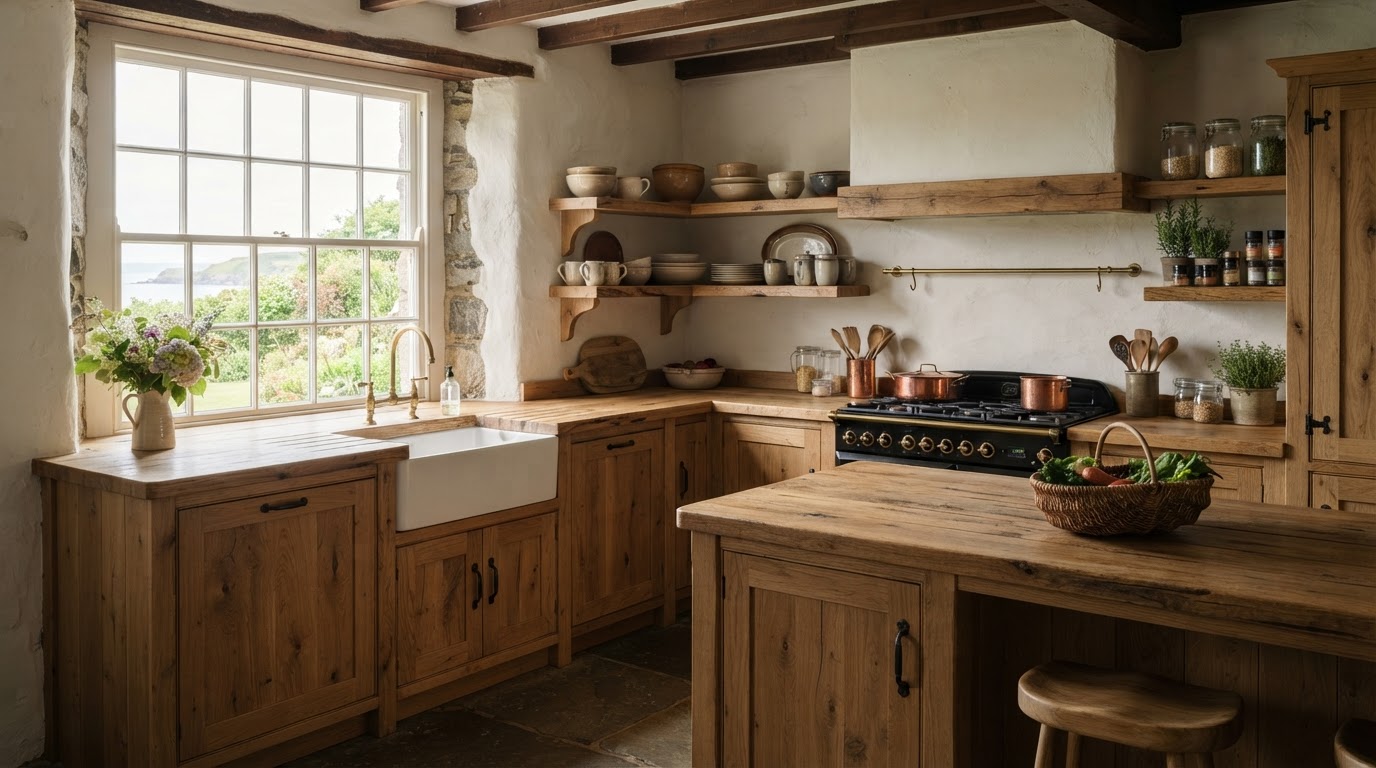
Reclaimed timber is wood that has already lived a life — floorboards from a demolished mill, beams from a barn, scaffold boards from a building site. Salvaged, cleaned, and re-machined, it carries a depth of colour and a richness of grain that new timber takes decades to develop, and it comes with an environmental footprint close to zero.
There is a craft to working with reclaimed timber. Old boards hide nails, screws, and grit that blunt blades and can spark off a planer, so each piece is metal-detected and prepped by hand. The reward is a material with genuine history — a floor or a worktop that is already proven to last, and that no new timber can match for character.
For Cornish homes especially, reclaimed timber feels right. It connects a new kitchen or a new floor to the material history of the county, and it sidesteps the environmental cost of felling new trees entirely. It is the most honest way to build with wood.
Certified New Timber: FSC and PEFC
Where reclaimed timber isn't suitable — and for some structural and painted work it isn't — certified new timber is the responsible choice. The Forest Stewardship Council (FSC) and the Programme for the Endorsement of Forest Certification (PEFC) are the two international schemes that certify timber from well-managed forests, and specifying FSC or PEFC timber means the wood can be traced back to a sustainable source.
We specify certified timber for carcass work, shelving, and any solid timber where reclaimed isn't appropriate. European oak, ash, and tulipwood are all readily available certified, as are softwoods like redwood and whitewood for painted work. The premium for certified timber is small, and the assurance it gives is considerable.
The point is not to be absolutist. It is to make a deliberate, informed choice about every piece of timber that goes into a project, so that the finished joinery is as responsible as it is beautiful. Certification is the simplest way to do that.
Local and British-Grown Timber
Beyond certification, locality matters. Timber grown close to home carries a smaller transport footprint, supports domestic forestry, and often suits the climate it is destined for. British-grown oak, sweet chestnut, larch, and Douglas fir are all excellent structural and finishing timbers, and they are increasingly available from well-managed UK woodlands.
Larch, in particular, has become a favourite for Cornish external projects — cladding, decking, and garden structures — because it is durable, home-grown, and weathers to a beautiful silver. Sweet chestnut is another underused British timber that rivals oak for durability outdoors. Choosing these species keeps the carbon footprint down and the local economy up.
When we can, we specify British-grown and, where possible, locally sourced timber. It is a quiet choice that the finished joinery doesn't advertise, but it is one of the most meaningful sustainability decisions in any project.
Low-Impact Finishes
The finish on a piece of joinery is the other half of its environmental story. Conventional solvent-based paints and varnishes release volatile organic compounds (VOCs) as they dry, affecting indoor air quality and the wider atmosphere. Low-VOC and water-based finishes have improved enormously and now match or exceed the performance of their solvent counterparts for most interior work.
For painted work, we use water-based, low-VOC paints that are hard-wearing and virtually odourless. For natural timber, we favour hard-wax oils and natural oils that penetrate the wood and allow it to breathe, rather than sealing it under a plastic film. These finishes are gentler to apply, gentler to live with, and gentler to dispose of.
A sustainable piece of joinery isn't just about the wood — it is about everything that goes on and around it. Specifying low-impact finishes is a detail that makes the whole project genuinely responsible from first cut to final coat.
Built to Last: The Most Sustainable Choice of All
The most sustainable piece of joinery is the one that doesn't need replacing. Bespoke furniture, built properly from quality materials and finished well, outlasts flat-pack equivalents many times over — a fitted wardrobe we build today could still be in use in fifty years, where a freestanding equivalent might be in landfill in ten.
That longevity is the deepest sustainability argument for bespoke carpentry. It is not just that the materials are better sourced, though they are. It is that the embodied energy and materials of one well-built piece spread across decades of use, rather than being repeated every few years with cheaper replacements.
When we design a piece, we design it to last. That is the real environmental case for bespoke joinery — and it is the one that matters most over the lifetime of a Cornish home.
Frequently Asked Questions
Quick answers to the questions we hear most about Eco-Friendly & Reclaimed Timber Carpentry in Cornwall.
Is reclaimed timber more expensive than new?+
Reclaimed timber can cost a little more due to the labour of salvaging and re-machining, but for many projects the character and environmental benefits are worth it. We can quote both options.
Can you source FSC-certified timber for my project?+
Yes. We specify FSC or PEFC certified timber as standard for new wood, and we can provide certification for any project that requires it.
Are your finishes low-VOC?+
Yes. We use water-based, low-VOC paints and natural hard-wax oils for the majority of our work, which are better for indoor air quality and the environment.
Related Articles

Maximising Space with Custom Wardrobes in Cornwall
Discover how bespoke fitted wardrobes can transform your bedroom, providing optimal storage solutions while enhancing your room's aesthetic appeal.

Choosing the Right Wood for Your Kitchen Carpentry
Not all wood is created equal. Learn about the best timber choices for durability, aesthetics, and moisture resistance in your custom kitchen.

How to Maintain Your Outdoor Decking in Cornwall
Cornish weather can be tough on timber. Here are our top tips for treating, cleaning, and maintaining your decking so it lasts for years.
Ready to Start Your Project?
Get in touch for a free, no-obligation consultation about your bespoke carpentry project in Cornwall.
Request A Quote